
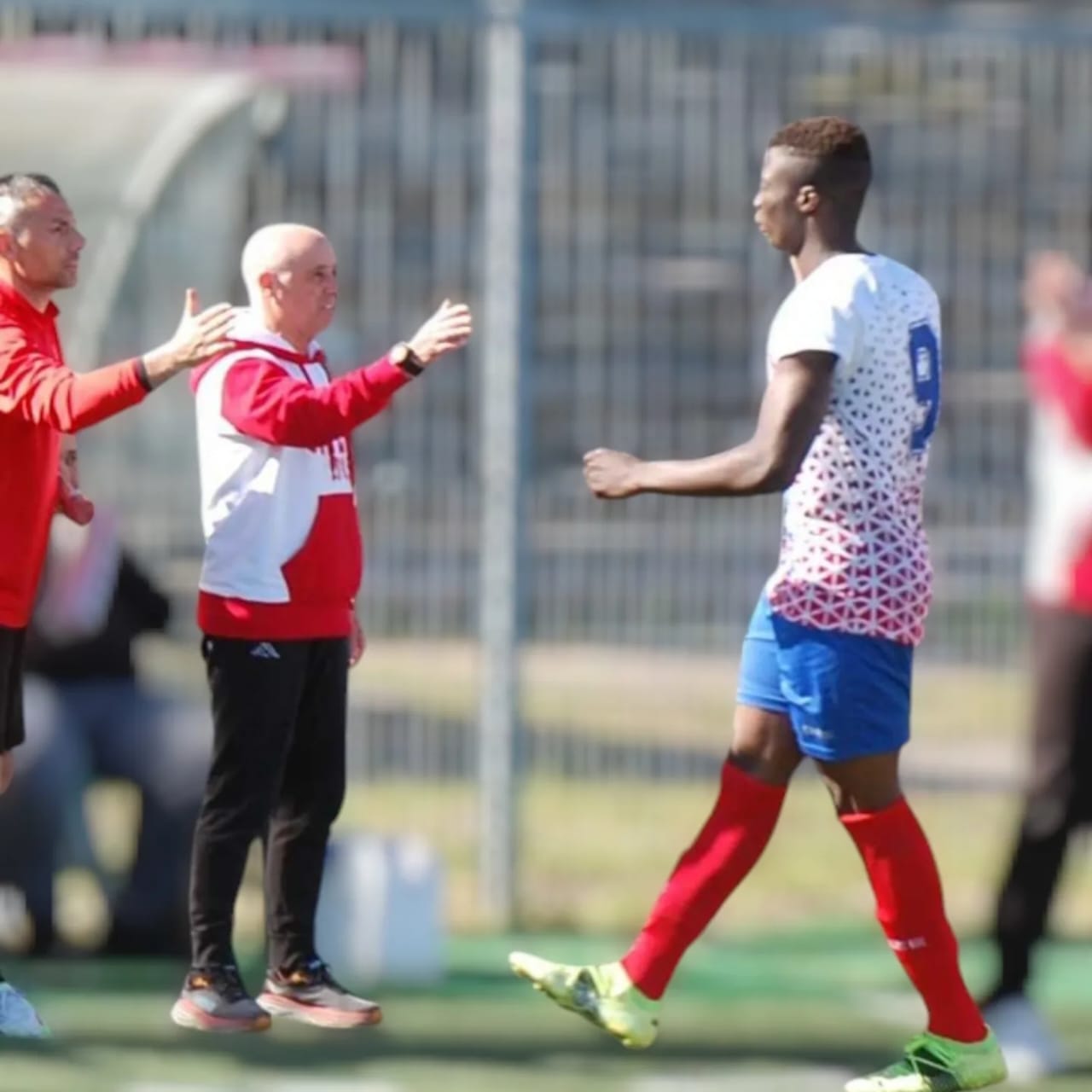
Adnan Aziz: The Rise of a Multi-Country Forward – From the Streets of Djougou to Europe’s Training Grounds and Now on the Edge of Nigeria’s Premier League
At 24, Adnan Aziz embodies a new archetype of the modern African footballer — shaped by multiple cultures, molded by three footballing systems, and driven by an unshakable belief that every chapter of his journey has prepared him for the next. Born on January 1, 2002, in Djougou, northern Benin, with a Beninese mother and a Nigerian father, Aziz grew up with two identities, two histories, and two footballing worlds beating inside him. Today, he stands on the brink of joining a club in the Nigerian Premier League (NPFL), a league symbolic of his roots and essential to his next leap forward.
Roots in Djougou: A Childhood Where Talent Met Tradition
Djougou is more than a city. For many northern Beninese families, it is a cultural crossroads where traditions blend with ambition. In the markets, the mosques, the small schools scattered around sandy roads, football is a constant hum in the background — a rhythm children grow up with.
For Aziz, it was the center of everything.
His mother is from the well-known Bania family, recognized in the region for its football lineage. Cousins, uncles, older brothers — football wasn’t just a pastime. It was a family signature. From an early age, he was surrounded by players, stories of tournaments, and the competitive culture of informal matches played in the dust.
His father, a Nigerian from a football country defined by intensity and hunger, pushed him in another direction: toward discipline, sacrifice, and ambition.
“When you grow up between Benin and Nigeria, you grow up with two energies,” he recalls.
“On one side, creativity and joy. On the other, hunger and toughness. Both shaped me.”
These early years taught him resilience: learning to play on uneven sand, dodging stones while dribbling, and chasing the ball in heat that exhausted many but motivated him.
First Steps in Benin’s Training System: Learning the Fundamentals
Aziz’s first structured football education came at Soleil FC, a respected academy in Benin known for discipline and technique. The coaches quickly identified a striking trait: he was always moving — scanning, adjusting, anticipating.
He wasn’t just talented; he had football intelligence beyond his age.
After Soleil FC, he joined Tchemabi FC, a club with a stronger competitive structure. Here, he learned:
offensive positioning,
fluidity in transitions,
timing of runs,
and how to combine instinct with tactical awareness.
This period built the foundational layer of the player he would become: quick, mobile, unpredictable, and clever in small spaces. By his mid-teens, he was already attracting attention beyond Benin’s borders.
And that set the stage for his biggest shift — Europe.
France: The School of Tactics, Discipline, and Mental Growth
France is not always an easy transition for young African players. The climate, professionalism, pace of training, and tactical structure can be overwhelming. Many struggle to adapt. Aziz found it challenging — but transformative.
Signing with Angers MFC, he discovered a level of structure and tactical rigor he had never experienced before. Training sessions were intense, repetitive, and physically demanding. The margin for error was smaller.
Aziz learned to:
press with timing,
track defensive movements,
adjust positioning according to the system,
and understand football not just as passion, but as mathematics.
He later moved to Saumur Olympique, where his game matured even more.
The coaching staff there emphasized physical conditioning, mental resilience, and decision-making under pressure. Facing stronger players forced him to grow quickly.
He developed:
robust hold-up play,
sharper finishing,
better anticipation,
and the patience required for a European forward.
“France taught me science,” he says.
“When to move, why to move, and how to move.”
This structured education gave him a new dimension.
. Italy: The Final Layer — Becoming a Complete Modern Forward
Italy became the environment that completed him.
Signing for ASD Juvenilia Roseto, Aziz entered a footballing world built on obsession: obsession with tactics, duels, defensive discipline, and explosive counterattacks.
Italian coaches did not just want his talent — they wanted perfection in detail.
Here, he learned to:
Play with his back to goal
Italy made him stronger, physically and mentally.
He learned to protect the ball, absorb contact, and turn defenders at the right moment.
Master transitions
Italian football often relies on fast, vertical play.
Aziz’s explosiveness made him deadly in these situations.
Understand spacing deeply
In Italy, spacing is sacred.
He learned how to drag defenders, create channels, and stretch backlines.
Finish under stress
Small chances, tight spaces, minimal time — Italian football sharpened his finishing instincts.
His coaches valued his:
mobility,
explosiveness,
tactical maturity,
and his willingness to learn.
Slowly, he transformed from a promising young attacker into a modern forward capable of matching diverse styles.
The Nigerian Premier League: A Return to Identity
Now, in 2026, Aziz is close to joining a professional club in the Nigerian Premier League (NPFL). The move feels natural and symbolic — Nigeria is the land of his father, the land of his earliest dreams, and one of Africa’s most competitive football ecosystems.
The NPFL is fast, physical, demanding, and emotionally charged.
It produces stars who move to:
South Africa,
North Africa,
Scandinavia,
Eastern Europe,
and increasingly MLS and the Middle East.
For Aziz, the NPFL is not just a league — it is a return to roots and a gateway to the next level.
“I want to play in Nigeria because it is part of who I am,” he says.
“My father is Nigerian, my childhood was between both countries. To play there is emotional, but also professional. I want to prove my value where football is passion.”
The interest he has received underscores his profile:
A hybrid forward with European training and West African instinct — a rare combination.
Technical Identity: What Makes Aziz Different?
Modern football celebrates versatility, mobility, and intelligence — and Aziz fits that mold.
● His strengths
Explosive acceleration, ideal for transitions
Excellent movement off the ball
Strong hold-up play, learned in Italy
Sharp technical first touch, shaped in Benin
Tactical intelligence, developed in France
Ability to combine and attack space
Mental resilience, from his multi-country journey
● His playing style
He is not just a finisher.
He is a forward who:
drops deep to create,
attracts defenders,
opens channels for wingers,
links the midfield with the attack,
presses intelligently,
and stretches defenses with diagonal runs.
● His mindset
What truly distinguishes him is his personality:
Quiet but ambitious, humble but driven, patient but hungry.
Every coach he has played under shares the same description:
“He listens. He learns. He adapts.”
That trait is invaluable in modern football.
A Story of Migration, Persistence, and Identity
Aziz’s story is not only football — it is the story of many young African players who travel through trials, continents, and cultural adjustments to carve out their place.
His path is shaped by:
the streets of Djougou,
the training fields of Benin,
the tactical laboratories of France,
the demanding intensity of Italy,
and now the emotional pull of Nigeria.
He represents a generation unbound by borders, forged by adversity, and driven by a dream bigger than themselves.
His journey is proof that potential is not linear — it grows through experiences, environments, failures, and reinventions.
What Comes Next?
The next few months could determine the trajectory of his entire career.
A successful move to the NPFL could:
expose him to stronger competition,
attract international scouts,
open doors to major African leagues,
and prepare him for moves abroad.
He is entering his prime years — 24 to 27 — the age where strikers typically find their peak efficiency.
Everything he has lived up until now — the three countries, the lessons, the sacrifices — is converging into this moment.
Conclusion: A Name That Will Echo Beyond Borders
From Benin’s dusty pitches to France’s structured systems, from Italy’s tactical intensity to the Nigerian league he is preparing to enter, Adnan Aziz’s path is a testament to the power of persistence and multicultural identity.
His story is still being written.
But today, one thing is clear:
Adnan Aziz is not just a player to watch — he is a player built for the modern game, built by two countries, and built by a journey that has only just begun.
About the Author