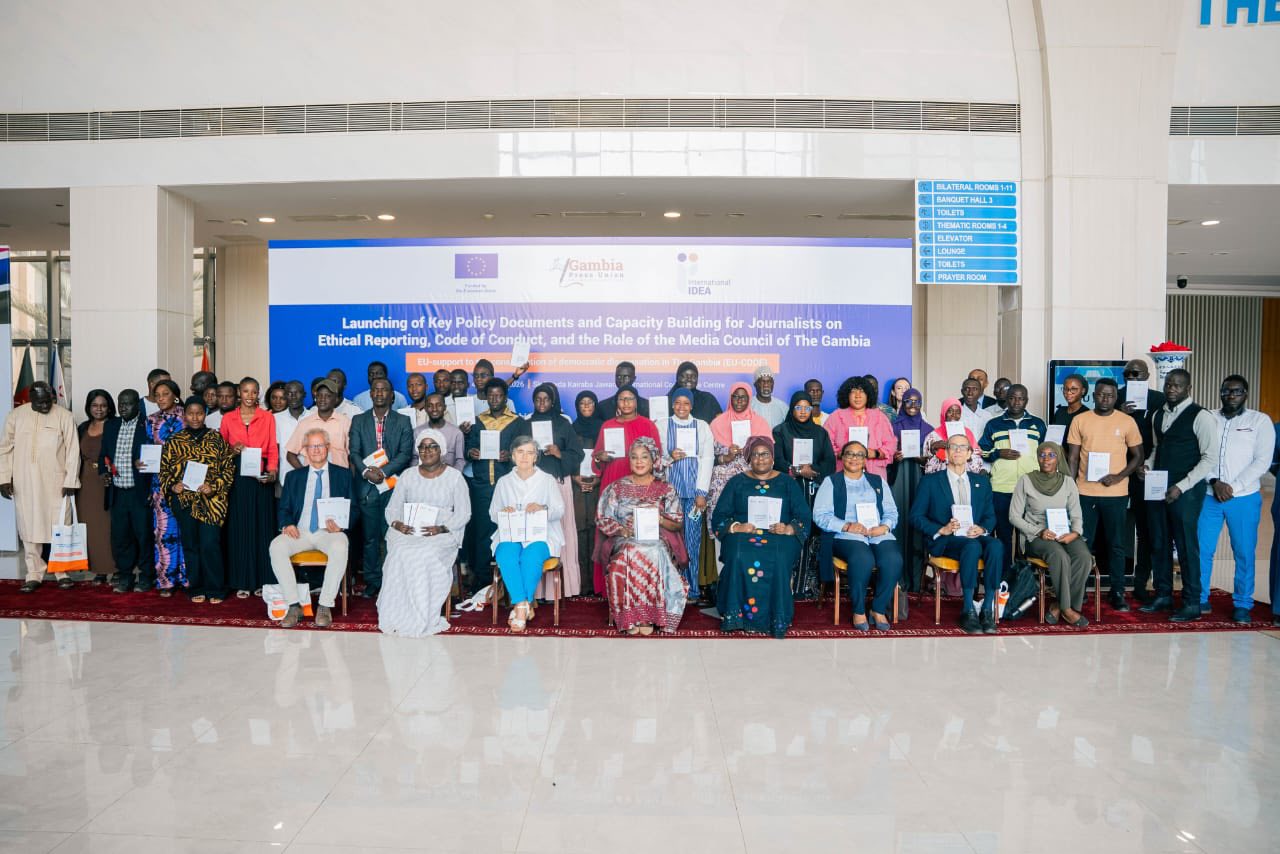
The Gambia Press Union (GPU), in partnership with the European Union and International IDEA , through the EU-CODE Project, has launched a set of media policy documents to strengthen ethical reporting, accountability mechanism and the role of the Media Council of The Gambia.
The launch took place during a two-day capacity building event, held from 3–4 February 2026 that brought together representatives from across The Gambia’s media landscape.
The three new landmark policy documents include:
• The Cherno Jallow Charter of Ethics for Journalists and Media Operators (2025);
• Towards Effective Complaints Mechanisms – Media Monitoring Guide for Ethical Violations (2025);
• Workplace Sexual Harassment Policy for Media Institutions (2026).
Representing the Government of The Gambia, Cordu L. Jabang, Permanent Secretary at the Ministry of Information and Broadcasting Services, expressed appreciation to the European Union and International IDEA for supporting the development of the policy documents. She described them as critical tools for strengthening ethical standards, accountability mechanisms, and safety within media workplaces.
On the occasion, the European Union Ambassador to The Gambia, H.E. Immaculada Roca i Cortés, reaffirmed the EU’s commitment to strengthening democratic governance in The Gambia, stressing that a “free, ethical, and responsible media is a cornerstone of any democracy”. While freedom of expression is fundamental, she also noted that “freedom must be complemented by strong ethical standards and effective accountability mechanisms. She added: “The policies being launched today offer practical guidance for journalists and media houses, clarify professional responsibilities, and reinforce the role of the Media Council of The Gambia as an independent regulator. Importantly, the training sessions that follow this launch will help ensure that these documents are not merely adopted but actively understood and applied in daily journalistic practice.”
Speaking at the launch, Jainaba Faye underscored the significance of the documents, noting that they move beyond theory to address the real-world challenges faced by journalists. She emphasized the critical role of the media as watchdogs of democracy, tasked with informing the public, shaping public discourse, and holding those in power to account.
“Through this launch, we aim to raise awareness and encourage widespread adoption by media institutions. However, adoption alone is not enough. There must be a clear understanding and full implementation of these policies. Only then will we achieve the meaningful impact they are intended to deliver,” she stated.
GPU President Isatou Keita also noted that the documents were developed to enhance professionalism, ethical conduct, safety, and accountability within the media sector. She highlighted that they provide practical frameworks for ethical reporting, effective self-regulation, safer workplaces, and addressing persistent challenges within the media environment.
Delivering the launch address, Dr. Fatou Jagne Senghore stressed the importance of media self-regulation and the responsibility of media managers to ensure the full implementation of the policy documents.
“In a rapidly changing media environment, marked by the expansion of digital platforms, media organisations and journalists face unprecedented challenges. As watchdogs, they must hold powerful individuals and institutions to account while maintaining independence, integrity, and adherence to ethical standards. Respect for ethical standards strengthens self-regulation and enhances the protection and safety of journalists and media professionals,” she said.
Following the official launch, consultants who supported the development of the documents facilitated in-depth sessions with participants to promote proper understanding and encourage their effective and sustained utilisation across media institutions. A total of 500 copies of each policy document were also formally handed over to the Gambia Press Union for onward distribution.
About the Author