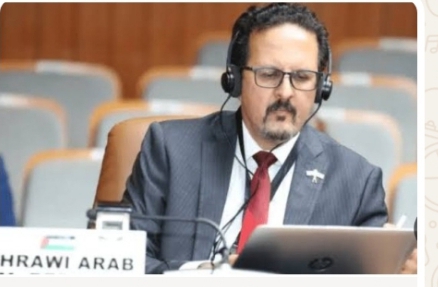
Ambassador **Malainin Lakhal**, Deputy Permanent Representative of the Sahrawi Republic to Ethiopia and the African Union, stated that Western Sahara expects Washington to use its weight to push for respect for the Sahrawi people’s right to self-determination—the same right through which the United States itself was founded. He added that what Sahrawis need now is stronger international solidarity, breaking the wall of silence surrounding the realities of the Sahrawi issue, activating international legal mechanisms against those involved in plundering their resources, and holding accountable the states and companies implicated.
He also described the “Makhzen system” as “a dangerous cancerous system implanted in our Maghreb body by France since 1912,” accused Morocco of violating international law and involving foreign powers in looting Sahrawi natural resources, and characterized European silence as “the silence of an accomplice.” He stressed that what has occurred is not mere delay but “political complicity imposed by international and regional balances.”
—
### DZ54:
For decades, there has been significant international delay in resolving the Western Sahara issue (and this is not accidental), despite the clarity of international law affirming the Sahrawi people’s right to self-determination. Recently, however, there seems to be some acceleration. How do you explain this?
### Ambassador Malainin Lakhal:
The delay was never due to legal ambiguity. International law is clear in classifying Western Sahara as a non-self-governing territory subject to a decolonization process and recognizes its people’s right to self-determination. What has happened is not delay but political complicity shaped by international and regional power balances and narrow interests that favored a colonial status quo over legality.
The current acceleration is due to several factors: the resilience of the Sahrawi people, the failure of policies aimed at imposing occupation, renewed international attention to the conflict, and growing contradictions in the positions of some major powers that claim to respect international law and human rights while supporting a colonial system.
One can also say that the continued struggle of the Sahrawi people has forced Morocco to seek a way out of its impasse. However, by insisting on solutions outside international legitimacy—such as imposing its colonial autonomy proposal—it risks creating a new crisis. This autonomy proposal is a ticking time bomb that could destabilize the Moroccan monarchy from within if imposed in any form, not only because it is rejected by Sahrawis and lacks legal basis, but because it contradicts the centralized nature of the Moroccan monarchy.
—
### DZ54:
Are you optimistic about Washington’s direct involvement in negotiations between the Polisario Front and Morocco? What do you expect from the American side?
### Ambassador Malainin Lakhal:
We have never rejected any international role, including that of the United States. American mediation is not new. The first Personal Envoy of the UN Secretary-General was former U.S. Secretary of State **James Baker**, followed by other high-level American mediators such as **Christopher Ross**, as well as diplomats like **Frank Ruddy** and **John Bolton**.
The only condition is that such mediation be positive, grounded in international legitimacy, and conducted under UN auspices. Any mediation outside this framework will not resolve the conflict but merely postpone and complicate it.
We expect Washington to use its influence to uphold the Sahrawi people’s right to self-determination—the very principle upon which the United States was founded after resisting British colonialism. Attempts to impose illegitimate solutions serving expansionist agendas will only deepen the crisis and could destabilize the entire region and even the African continent, whose African Union was founded on respect for borders and rejection of colonialism and expansion.
—
### DZ54:
Do limited resources affect Polisario’s ability to push for a referendum? What exactly do Sahrawis need to become a stronger pressure force?
### Ambassador Malainin Lakhal:
Resources matter, but they are not decisive. History has shown that peoples with legal legitimacy, political will, and a clear national project can prevail even with limited means.
The Sahrawi people have demonstrated remarkable resilience over fifty years—living in exile, diaspora, and under occupation, facing immense hardships and international opposition.
What Sahrawis need now is greater international solidarity, breaking the silence surrounding their cause, activating international legal mechanisms against those involved in resource exploitation, holding accountable states and companies complicit in looting, and mobilizing genuine political support for respect of international law. Pressure does not come solely from military resistance but from internationalizing the conflict legally and morally.
—
### DZ54:
It appears to be a struggle between legal legitimacy that remains practically unresolved and a de facto occupation sustained by international and regional balances. How do you propose to break this deadlock?
### Ambassador Malainin Lakhal:
There is no real deadlock. Anything built on falsehood is false. Imposing faits accomplis through force contradicts both moral and international law.
No peace can be achieved outside the application of international legitimacy and UN principles on decolonization and self-determination. Occupation, no matter how long it lasts or how powerful it appears, remains abnormal and fragile.
True political realism lies not in legitimizing violations but in ending them in accordance with international law and the will of the Sahrawi people, the sole holders of sovereignty. Solutions that bypass the law in other conflicts have failed and often reignited violence.
—
### DZ54:
New generations have been born in refugee camps and face harsh living conditions. Does this create social pressure on the Polisario Front?
### Ambassador Malainin Lakhal:
It is natural for new generations to create social and human pressure in any society. This is not a weakness but a source of accountability and renewal.
These generations did not choose exile but were raised on the resistance of their parents. They understand that giving up their rights would not grant them a normal life but condemn them to permanent injustice. The Polisario Front must continue adapting and evolving without compromising core principles.
—
### DZ54:
What investments is Morocco making in occupied Western Sahara? Is this the reason behind European silence or economic cooperation with Morocco?
### Ambassador Malainin Lakhal:
Morocco involves foreign powers in exploiting Sahrawi natural resources—phosphates, fisheries, and renewable energy—in blatant violation of international law. These investments do not promote peace or stability; they deepen the occupation.
The Polisario Front has repeatedly warned states and companies to stop supporting the occupation through such investments and has pledged to pursue those involved legally.
As for European silence, it is unfortunately the silence of an accomplice. Some states openly support the occupation. However, this is short-sighted. The Sahrawi people will prevail, and Western Sahara will be liberated. Europeans should understand the lessons of history and pressure Morocco to comply with international legitimacy—or at the very least, stop protecting and economically supporting it.
About the Author